
Weight Loss - Explained!

How my body works
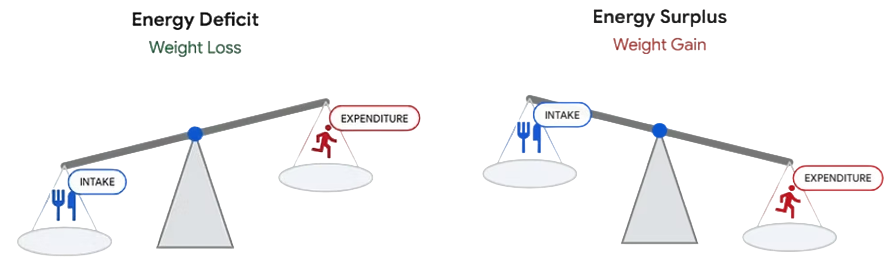
It’s important to understand how the body gains and loses weight so you can learn how to lose weight effectively and keep it off. Your body needs energy to stay alive and to move, and it gets this energy from the food you eat. When you eat more energy than your body needs, the excess energy is stored, commonly in adipose (fat) tissue. One day of overeating won’t make a big difference, but consistently eating more than your body uses over time can lead to weight gain.
This ability to store energy is important and helpful process that helps humans survive during times when food is scarce. The body also has a process when it doesn’t receive enough energy, it will use its own energy storages for energy. With food being so easy to access nowadays, overeating can happen easily and lead to weight gain. We usually call the energy you get from food “energy intake” and the energy your body uses to function and move “energy expenditure.”
What influences Energy Intake?
We know the energy your body gets comes from the food and drinks you consume. However, the energy in the food are mainly from four main sources: carbohydrates, protein, fat, and, to a lesser extent, alcohol. Each of these provides a different amount of energy per gram.
Macronutrient | Energy Content |
Carbohydrates and Protein | 16.7kJ/g |
Alcohol | 29.3kJ/g |
Fat | 37.7kJ/g |
Most foods are a combination of these macronutrients, which means different foods contain different amounts of energy. This is where the concept of energy density becomes important. Energy density refers to the amount of energy (kilojoules or calories) contained in a given amount of food, usually based on its weight or size.
Some foods are high in energy density, meaning they contain a lot of energy in a small portion. Others are low in energy density, meaning you can eat a larger amount while consuming fewer calories.
For example, a single Tim Tam biscuit can contain a similar amount of energy as a banana. However, most people won’t feel very full after eating one Tim Tam, while a banana is much more filling. This is because the banana has lower energy density and higher volume, helping you feel satisfied with fewer calories.
 1 x Timtam (18.3g) |  Cavendish Banana (100g) | |
Total Energy | 401kJ | 399kJ |
Carbohydrates | 11.9g | 19.9g |
Protein | 0.8g | 1.4g |
Fat | 4.9g | 0.2g |
Alcohol | 0g | 0g |
What influences energy expenditure?
Your body uses energy in three main ways throughout the day.
1. Basal Metabolic Rate (BMR)
This is the amount of energy your body needs to stay alive at rest. It supports essential functions such as:
keeping your cells working
producing and using hormones and enzymes
transporting substances around the body
maintaining body temperature
keeping vital organs like the heart and brain functioning
BMR makes up about 45–70% of your total daily energy expenditure, making it the largest contributor. It is influenced by factors such as age, sex, body size, and body composition. While it can change slightly over time, it is not something you can significantly increase through short-term actions.
2. Diet-Induced Thermogenesis (DIT)
This is the energy your body uses to digest, absorb, and process the food you eat. It typically accounts for about 10% of your daily energy expenditure.
3. Physical Activity
This includes all movement you do throughout the day, from structured exercise to everyday activities like walking, cleaning, or standing. Physical activity is defined as any movement produced by muscles that requires energy. This is the most variable part of energy expenditure and the one you have the most control over.

Does everyone gain or lose weight at the same rate?
Everyone’s ability to gain and lose weight varies significantly. A study looking at 24 young adult males who were overfed by 1000 kcal/day for 100 days resulted in very different amounts of weight gain.1 Despite consuming the same excess calories, some participants gained considerably more weight than others. This highlights how there are many factors such as genetics, hormone levels, gut health, sleep, stress, and daily movement can all influence how the body manages weight.

Reference
Dériaz O, Tremblay A, Bouchard C. Non linear weight gain with long term overfeeding in man. Obes Res. 1993 May;1(3):179-85. doi: 10.1002/j.1550-8528.1993.tb00609.x. PMID: 16353352.


Comments